Top OSHA Violations in Commercial Printing: What Every Print Shop Needs to Know
How to Identify, Prevent, and Stay Ahead of the Most Common OSHA Citations in Printing Operations
OSHA's most frequently cited violations in commercial printing follow a clear pattern. They concentrate where printing shops run high-energy equipment, handle chemical products daily, and move materials fast. The same core standards show up year after year, and the facilities that avoid repeat citations are the ones with simple, living programs that are trained, documented, and visible on the shop floor (1)(2).
Understanding where violations cluster gives you a clear starting point for reducing risk and strengthening compliance across your operation.
Most Frequently Cited OSHA Standards in Printing Facilities
Industry-specific tracking consistently places the same standards at the top of the violation list for commercial printing operations (2)(3):
- Hazard Communication (HazCom): 29 CFR 1910.1200
- Lockout/Tagout (LOTO), Control of Hazardous Energy: 29 CFR 1910.147
- Machine Guarding: 29 CFR 1910.212
- Powered Industrial Trucks (PITs): 29 CFR 1910.178
- Respiratory Protection: 29 CFR 1910.134
- OSHA Recordkeeping: 29 CFR 1904
These aren't isolated findings. They reflect the daily realities of printing: chemical handling across ink rooms and press lines, high-energy equipment in pressrooms and bindery, powered trucks moving materials through tight spaces, and production pressure that can push safety controls to the side.
Why OSHA Violations Repeat in Printing Operations
Most repeat citations don't come from a lack of effort. It's a gap between what's written and what's actually happening on the floor. Programs exist but aren't run consistently across shifts. Responsibilities are unclear between departments. Documentation doesn't match reality, with training rosters incomplete, inspections not done, or procedures too generic to be useful. And minor routine tasks get treated as "too small for LOTO" until someone gets hurt or OSHA asks for procedures.
Hazard Communication Violations in Print Shops
HazCom violations are among the most common citations in printing because chemical handling is constant, from inks and solvents to cleaners, coatings, and press-side transfer containers (4)(5).
Common issues include outdated or generically written HazCom programs, incomplete SDS libraries, unlabeled secondary containers like squirt bottles and cups, and training that isn't documented or repeated when new chemicals arrive. A strong HazCom program matches your real chemical flow, from receiving through ink room storage, press-side use, cleaning, and waste handling. Your SDS library should be accessible even during network downtime, and labeling needs to be simple enough that employees actually follow it.
Lockout/Tagout Compliance for Printing Equipment
LOTO violations in printing often come down to missing machine-specific procedures for common equipment like cutters, folders, stitchers, presses, conveyors, and compactors. Employees clearing jams or making adjustments without proper energy isolation is a frequent finding, and annual procedure inspections are often missing or undocumented.
A strong LOTO program includes an energy control survey for every relevant machine covering all energy types, machine-specific procedures that match real steps and real lock points, a clear rule for minor servicing versus full LOTO that's enforced consistently, and annual inspections documented with corrections tracked to closure.
Machine Guarding Requirements for Presses and Bindery Equipment
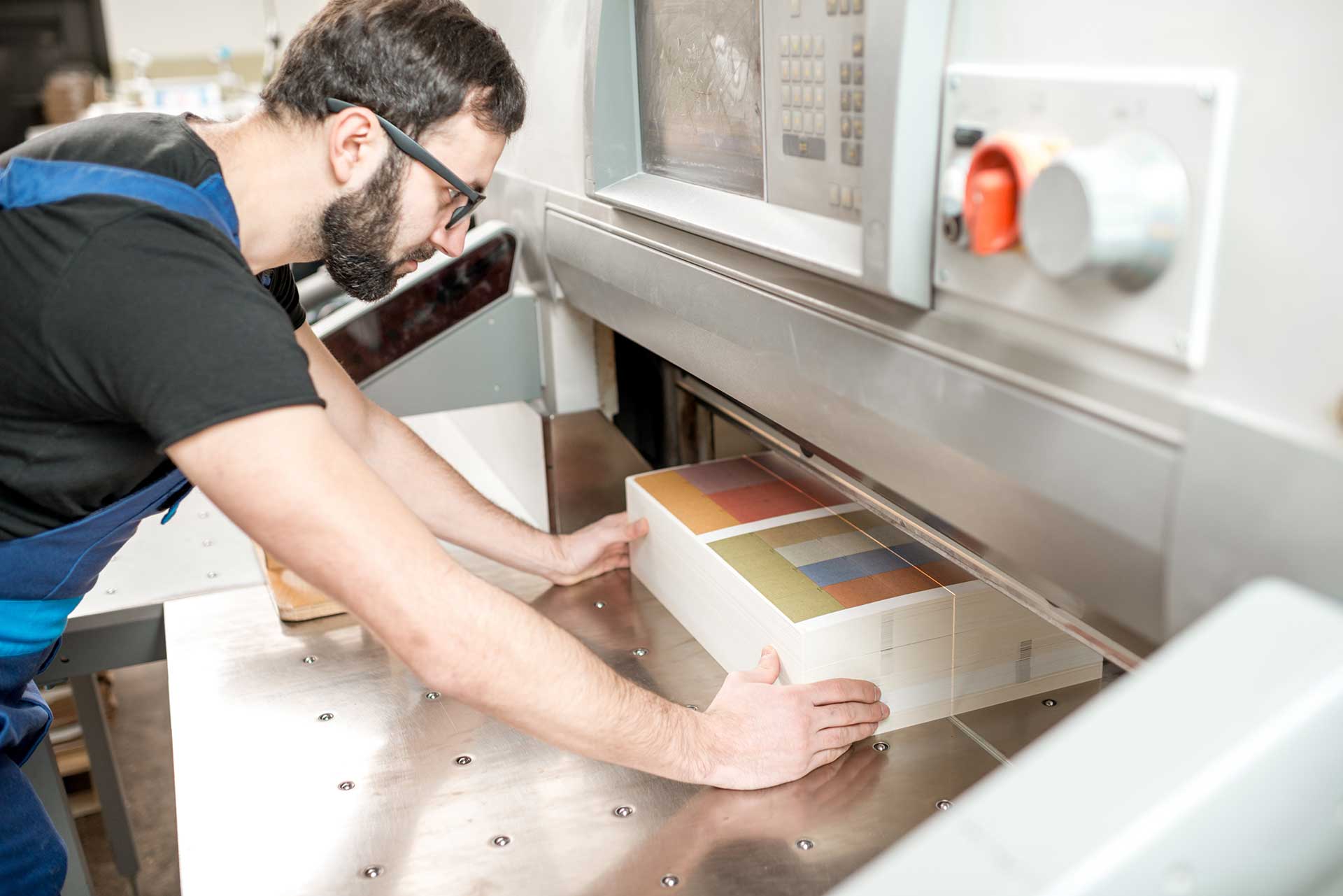
Machine guarding citations are common in bindery and finishing operations where nip points, pinch points, and rotating parts create exposure. Guards that are missing, damaged, removed after maintenance, or bypassed interlocks that keep production moving are frequent findings.
The fix starts with a department-by-department guarding assessment across press, bindery, packaging, conveyors, and waste compaction. A hard rule against defeating interlocks, a quick-response repair workflow so production doesn't normalize broken guards, and verification checks built into daily start-up or shift change routines all help close this gap.
Forklift and Powered Industrial Truck Safety in Printing
Powered industrial trucks are consistently among the most frequently cited OSHA standards across all industries, and printing is no exception (1). Common issues include incomplete or outdated operator training, missing evaluations, pre-use inspections that aren't being done, and informal traffic management around pedestrians, dock areas, and blind corners.
A compliant program includes operator training plus documented evaluation for each operator and truck class, real pre-use inspection logs that are reviewed, a clear out-of-service process for defects, and a traffic plan that matches the actual shop flow with marked pedestrian zones, speed expectations, and dock rules.
Respiratory Protection Program Compliance for Printers
Respiratory protection violations often stem from respirators being used without a written program, missing medical evaluations or fit testing, or voluntary use that's completely unmanaged. The first step is determining whether respirators are truly required based on exposures and tasks. If they are, you need a written program, medical evaluations, fit testing, training, and maintenance rules. If use is voluntary, you're still required to provide Appendix D information to employees and document it.
OSHA Recordkeeping Mistakes in Printing Facilities
Recordkeeping citations are often overlooked but can add up quickly. Common issues include misclassifying recordable cases as first aid, late or incomplete 300 and 301 entries, and not posting the 300A summary on time or in the right location. OSHA requires the 300A to be posted from February 1 through April 30, and records must be retained for five years (6)(7).
Assigning recordkeeping to a trained owner, running a monthly review cadence, and building a year-end closeout workflow all help keep this on track.
How to Reduce OSHA Citations in Your Print Shop
Fewer violations start with execution controls, not training alone. Shop-floor checklists tied to the shift start, role clarity by shift for who owns LOTO compliance and who reviews PIT defects, visual controls like LOTO placards and label stations at chemical transfer points, and a correction loop that tracks findings to closure. Training supports these controls, but it's the systems underneath that make the difference.
Training supports these controls, but it's the systems underneath that make the difference.
OSHA Compliance Support for Commercial Printers from GMG EnviroSafe
GMG EnviroSafe works alongside commercial printing facilities to build compliance programs that run on the floor and hold up under scrutiny.
Our support commonly includes:
- Printing-specific OSHA risk assessments covering HazCom, LOTO, machine guarding, PITs, respiratory protection, and recordkeeping.
- Facility-specific program buildouts for HazCom, LOTO energy surveys, machine-specific procedures, and PIT training documentation.
- Shop-floor inspection workflows focused on guards, trucks, electrical, chemical labeling, and corrective action tracking.
- Recordkeeping support including form management, case classification guidance, and 300A posting compliance.
- Evidence package setup so your written programs, training rosters, inspection logs, and corrective actions are organized and accessible.
The goal is a set of programs that your team can execute consistently, that match the realities of your shop floor, and that stand up to scrutiny when it matters.
If you'd like support assessing your OSHA compliance exposure or strengthening your printing safety programs, GMG EnviroSafe is here to help.
---
Sources
(1) Occupational Safety and Health Administration (OSHA). (2025). Top 10 Most Frequently Cited Standards. https://www.osha.gov/top10citedstandards
(2) PRINTING United Alliance. (2025). The Top 10 OSHA Violations in Printing for 2024. https://www.printing.org
(3) PRINTING United Alliance. (2026). Staying Ahead of OSHA: 2025's Top 10 Violations for Printing Operations. https://www.printing.org
(4) Occupational Safety and Health Administration (OSHA). 29 CFR 1910.1200 Hazard Communication. https://www.osha.gov/hazcom
(5) Electronic Code of Federal Regulations (eCFR). 29 CFR 1910.1200 Hazard Communication. https://www.ecfr.gov/current/title-29/subtitle-B/chapter-XVII/part-1910/subpart-Z/section-1910.1200
(6) Occupational Safety and Health Administration (OSHA). OSHA Recordkeeping Requirements. https://www.osha.gov/recordkeeping
(7) Occupational Safety and Health Administration (OSHA). Injury and Illness Recordkeeping Forms: 300, 300A, 301. https://www.osha.gov/recordkeeping/forms